1. Image Enhancement Fundamentals
Image enhancement is the process of manipulating an image so the result is more suitable than the original for a specific application.
- Key Goals: Highlighting interesting details, removing noise, and making images more visually appealing .
- Problem-Oriented: Enhancement techniques are highly specific; a method used for enhancing X-ray images may not be suitable for satellite images .
Spatial Domain Methods
Spatial domain operations operate directly on the pixels of the image and can be reduced to the form:
Where
Point Processing
The simplest spatial domain operation occurs when the neighborhood is just the pixel itself
Where
2. Basic Intensity Transformation Functions
There are three basic types of mathematical functions used frequently for image enhancement: Linear, Logarithmic, and Power-Law .
A. Linear (Identity & Negative)
-
Image Negatives: The negative of an image with intensity levels in the range
is given by: -
Application: Highly suitable for enhancing white or gray details embedded in large dark/black regions of an image .
B. Logarithmic
-
Log Transformation: Maps a narrow range of low (dark) input gray-level values into a wider range of output values.
-
Application: Particularly useful for expanding the dark pixels in an image while compressing the higher-level values. It is famously used to reveal more detail in the Fourier spectrum of an image .
-
Inverse Log: Performs the exact opposite transformation.
C. Power-Law (Gamma)
-
Gamma Transformation: Maps values based on an exponent
. -
Behavior: Fractional values of
(where ) map a narrow range of dark input values into a wider range of output values. Higher values of (where ) do the opposite. -
Gamma Correction: Display monitors often do not respond linearly to different intensities (they naturally darken images). A power-law transformation is used to precondition the image before display to correct this hardware phenomenon .
3. Piecewise-Linear Transformation Functions
Unlike standard mathematical functions, piecewise linear functions can be arbitrarily complex, allowing for highly customized intensity mappings .
A. Contrast Stretching
Contrast is the difference between the minimum and maximum pixel intensity in an image . Low contrast can result from poor illumination, lack of dynamic range in the sensor, or wrong lens aperture settings .
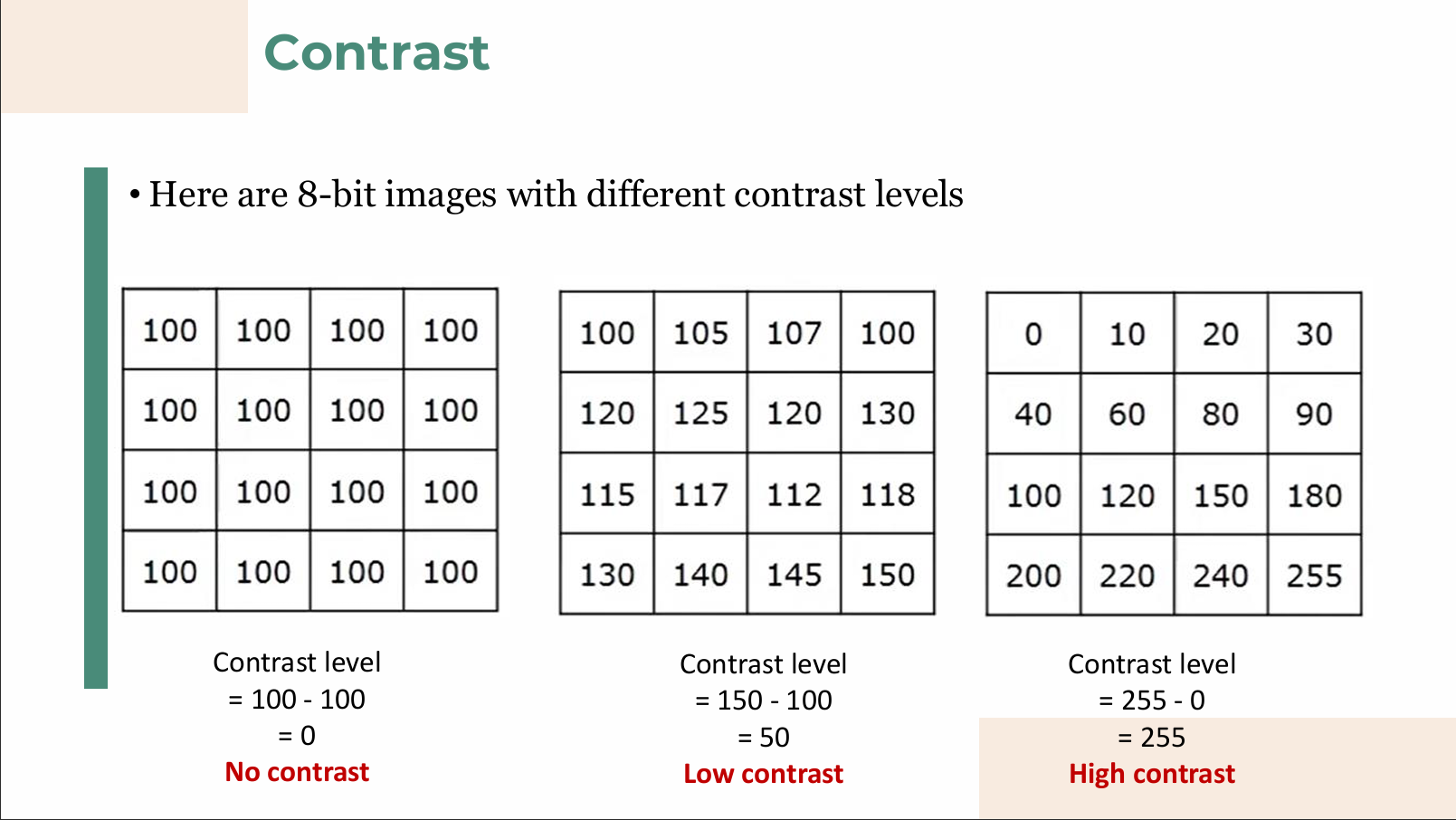
- Definition: A process that expands the range of intensity levels in an image so that it spans the full available intensity range of the display device (also known as normalization) .
- Min-Max Stretching Equation:
Where is the input intensity, is the output, is the target range (usually 0 to 255), and is the original intensity range .
- Global vs. Local:
- Global: Increases contrast across the entire image uniformly.
- Local: Divides the image into small regions and performs contrast enhancement on each region independently .
B. Thresholding
Thresholding converts a grayscale image into a binary image by comparing every pixel to a specific threshold value
- Process: If a pixel's intensity is greater than or equal to the threshold, it is mapped to 1 (or 255/White). If it is below the threshold, it is mapped to 0 (Black) .
To see numerical examples, here
Summary
| Transformation Type | Mathematical Formula | Behavior / Characteristics | Primary Application |
|---|---|---|---|
| Image Negative (Linear) | Reverses the intensity levels of an image. | Enhancing white or gray details embedded in large dark/black regions (e.g., medical X-rays). | |
| Logarithmic | Expands a narrow range of dark input values while compressing higher-level values. | Revealing hidden details in images with massive dynamic ranges, like the Fourier spectrum. | |
| Power-Law (Gamma) | Maps values based on an exponent. • • |
Gamma Correction: Preconditioning images to display correctly on monitors that do not respond linearly to intensity. | |
| Contrast Stretching (Piecewise-Linear) | Stretches the original intensity range to span a new, wider target range (usually |
Normalizing images with poor illumination or fixing low dynamic range sensor captures. | |
| Thresholding (Piecewise-Linear) | Maps pixels above a threshold |
Binarizing an image to segment or isolate specific objects from the background. | |
| (Note: |