The Frequency Domain Filtering Process
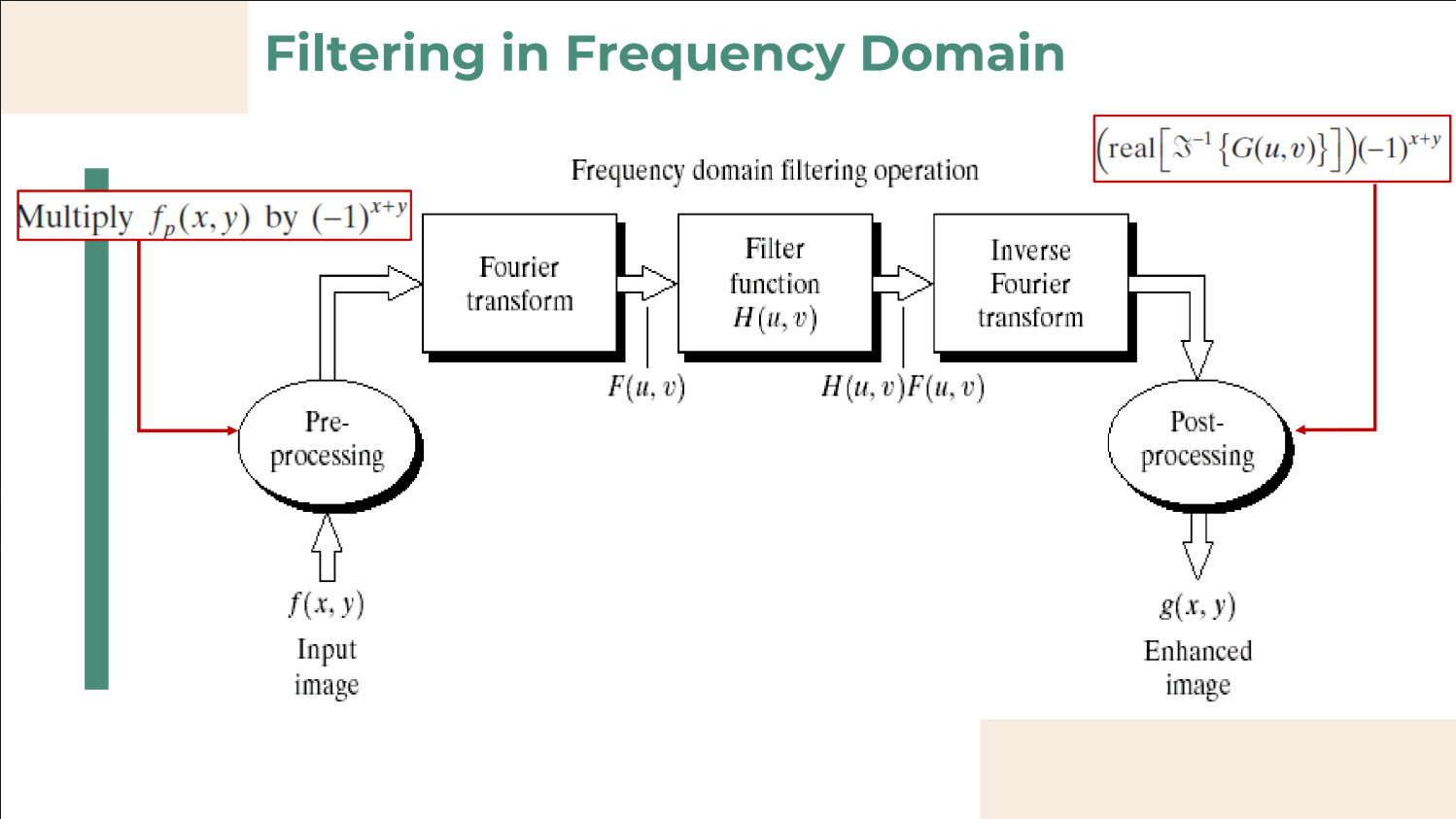
This lecture builds on the basics of the Fourier Transform to show how we practically apply filters to images. Because spatial convolution is equivalent to frequency domain multiplication, we can process images much faster by multiplying their frequency components by a filter function
The complete filtering pipeline involves five steps:
-
Pre-processing: Center the Transform by multiplying the input image
by , then compute its Discrete Fourier Transform (DFT), . -
Filtering: Multiply the centered DFT by the filter function
to get . -
Inverse Transform: Compute the Inverse DFT of the filtered result
. -
Extract Real Part: Take the real part of the inverse transform result.
-
Post-processing: Un-center the image by multiplying it again by
to get the final enhanced image .
Understanding Image Frequencies
To choose the right filter, you have to understand what frequencies represent in an image:
-
Low Frequencies: Represent areas where gray levels change very little over distance, such as smooth backgrounds or skin textures.
-
High Frequencies: Represent areas with large, rapid changes in gray levels, such as sharp edges, fine details, and noise.
The Two Main Filtering Categories
Filters are categorized by which frequencies they allow to "pass" through:
-
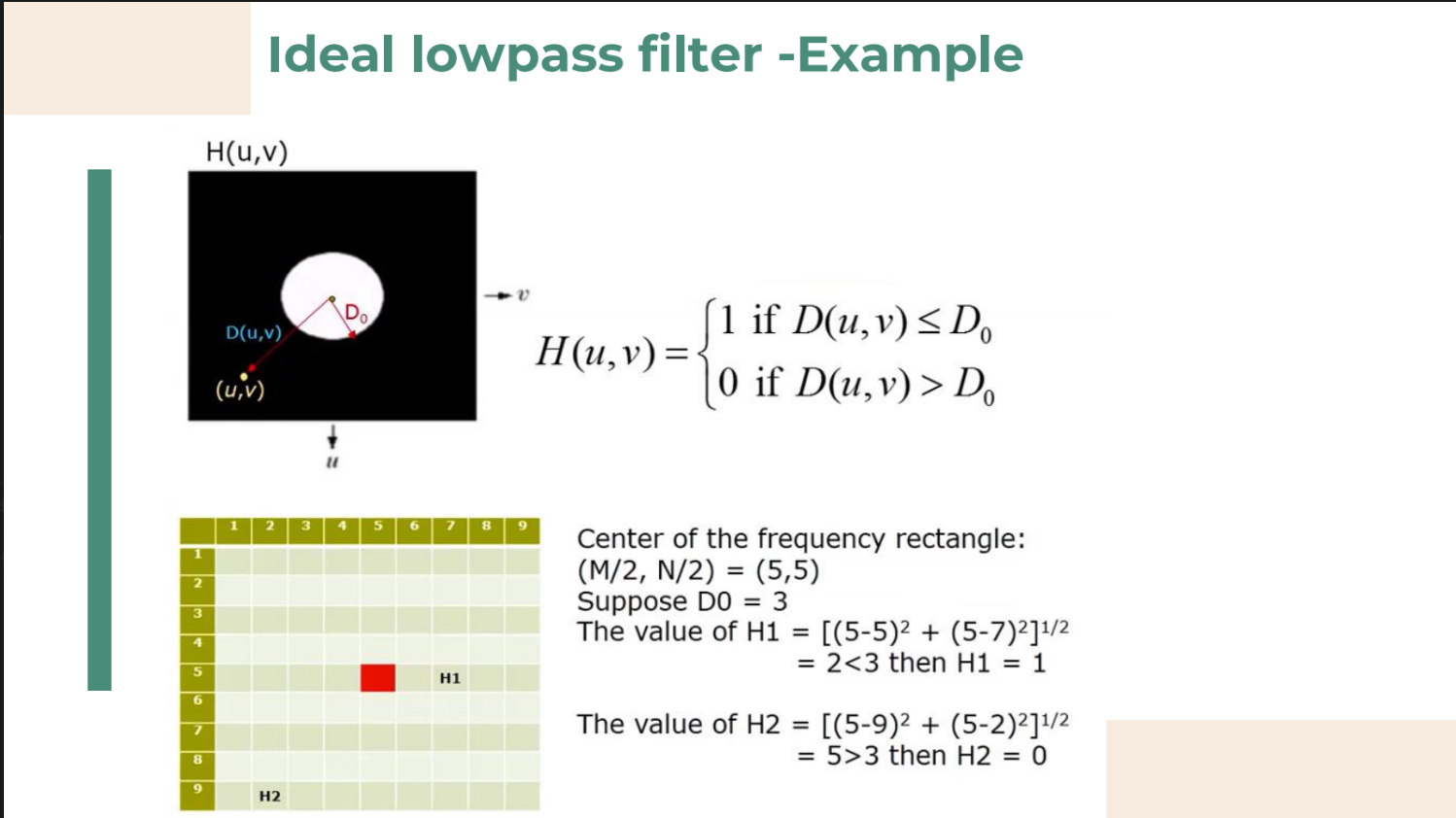
Lowpass Filters (Smoothing): These allow low frequencies to pass while attenuating (reducing) high frequencies. Because high frequencies contain edges and noise, reducing them results in a blurred or smoothed image. They are useful for joining broken text characters or smoothing out skin blemishes.
-
Highpass Filters (Sharpening): These allow high frequencies to pass while attenuating low frequencies. This drops the smooth background and highlights edges and fine details. Mathematically, a highpass filter is simply the exact reverse of a lowpass filter:
.
Comprehensive Comparison of Filter Shapes
Whether you are smoothing (Lowpass) or sharpening (Highpass), there are three primary mathematical shapes used for the filter function
Here is a complete comparison of the three methods:
| Feature | Ideal Filter (ILPF / IHPF) | Butterworth Filter (BLPF / BHPF) | Gaussian Filter (GLPF / GHPF) |
|---|---|---|---|
| Cutoff Style | Extremely sharp, abrupt cutoff at distance |
Smooth transition, controlled by an order parameter |
Very smooth, gradual exponential decay. |
| Mathematical Definition (Lowpass) | $$H(u,v) = \begin{cases} 1 & \text{if } D(u,v) \le D_0 \ 0 & \text{if } D(u,v) > D_0 \end{cases}$$ | $$H(u,v) = \frac{1}{1 + [D(u,v)/D_0]^{2n}}$$ | $$H(u,v) = e^{-D^2(u,v) / 2D_0^2}$$ |
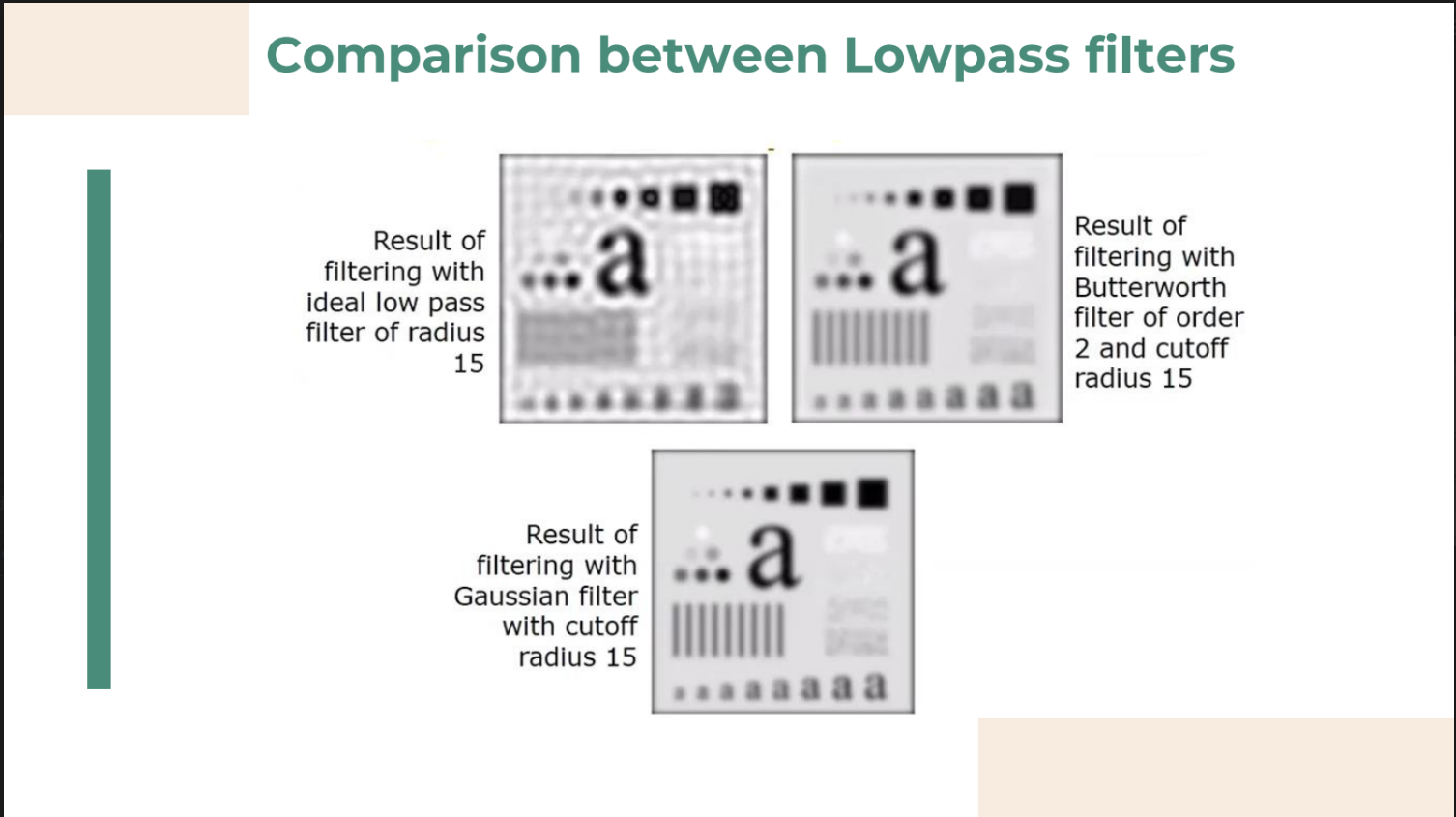
| Ringing Effect | Severe. The sharp cutoff creates distinct, visible ripples (ringing) around edges in the filtered image. | Variable. Ringing depends on order |
None. The smooth transition guarantees that absolutely no ringing artifacts will appear. |
| Practical Usage | Rarely used in practical applications due to the severe ringing artifacts. | Highly versatile. An order of |
Highly practical, especially when any form of artifacting (ringing) is unacceptable, such as in medical imaging. |
| Visual Result | Heavy blurring/sharpening but with noticeable, distracting "echoes" around sharp objects. | Balanced blurring/sharpening. Edges remain relatively clean without excessive echoing. | Very smooth blurring/sharpening, but requires a lower |
For Highpass, just 1 - Lowpass, and for Butterworth just flip the ratio